
Allen County VINELink Coverage
The Allen County Sheriff’s Corrections page links VINE as its published online route for county-jail release questions. Kansas VINE is described by the Kansas Attorney General as a free, confidential, voluntary notification service with live operator help. Its Kansas custody coverage is limited to people housed in county jails.
That limit is central. Allen VINE can report an Allen County Jail custody event. It does not include Kansas Department of Corrections prisoners. A person who transfers from the Allen County Jail into KDOC custody has left the county record’s lane but has not necessarily entered the community. KASPER is the state-prison source. The BOP locator, federal docket, or ICE locator must be used when those agencies control custody.
| Custody lane | Use VINELink? | Correct source |
|---|---|---|
| Allen County Jail | Yes | Kansas VINE, then jail confirmation |
| KDOC prison or parole | No | KASPER and KDOC Victim Services |
| Federal sentence | No | BOP Inmate Locator |
| ICE detention | No | ICE Online Detainee Locator |
VINELink is not a court-history archive. Kansas CaseSearch can preserve the legal trail after a jail event, but an order alone does not prove the moment of physical exit.
The Allen County Jail may end custody through bond, time served, dismissal, a court-directed release, or transfer. VINELink reports the participating jail’s event rather than interpreting the entire criminal case. If the event is release on bond, the case can continue. If the event is transfer, the receiving agency becomes the next source. This is why the custody label and listed location must be read before a result is described.
Search One Allen County Inmate
Use the web or app route and focus on one person. Names can collide, so a matching spelling is not enough. Compare all identifiers the result offers and make sure the listed custodian is Allen County.
- Open VINELink and select Kansas.
- Enter the available name or identification details.
- Open the possible Allen County result and compare identity fields and location.
- Read the event literally. Release, transfer, and escape describe different outcomes.
- Call the Allen County Jail at 620-365-1402 when exact discharge details are needed.
A blank search does not prove release. Data may lag, the name may differ, another custodian may hold the person, or the record may no longer appear the same way. The broader Allen County released inmate search reconciles county, court, state, and federal channels.
If several records look alike, pause before registering. Compare middle names, age or birth information, booking identifiers, and the named facility when those fields are visible. A notification attached to the wrong person can create needless confusion. When the live result exposes too little detail to make a safe match, the Allen County Jail can confirm whether the person and booking are within its custody.
The public VINELink state-selection interface is the entry point for an Allen County-specific search.
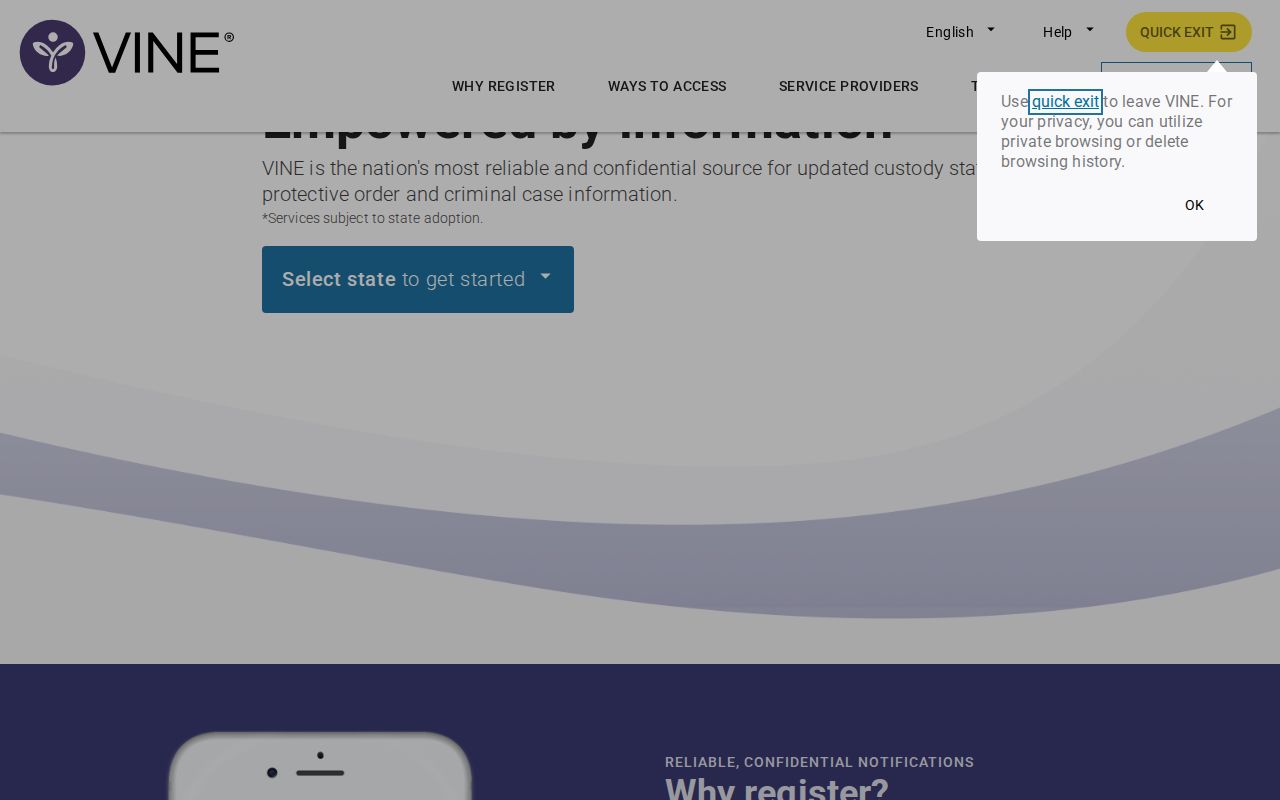
Selecting Kansas first keeps the query within the right service before identity and Allen County location are compared.
Allen County VINELink Release Fields
A VINELink record is a custody-notification record. The exact live fields may vary, but useful items identify the person, holding location, current event, and notification choices.
| Field | How to read it |
|---|---|
| Name or identifier | Match more than one identifier to avoid a same-name error. |
| Location or custodian | Confirms whether the event belongs to Allen County custody. |
| Custody status | Describes the event reported by the participating jail. |
| Release event | Supports exit from the named county custody, subject to confirmation. |
| Notification options | Lists live phone, text, email, TTY, or app channels. |
“Released” supports an end to the named Allen County custody. It does not clear all holds, prove that no supervision follows, or state why the person left. “Transfer” means another custodian may now control the person. “Escape” must not be reframed as release. Request the sheriff’s discharge date, time, and authority when precision matters.
The permanent county Jail/Commitment Record can preserve more detail than the notification screen. Kansas’s retention schedule includes the discharge date, discharge time, and authority, along with booking and commitment information. A formal Allen County records request can seek those exact fields for a historical answer. Restricted information may be redacted, but the narrow request still gives the custodian a clear description of the needed event.
Register for Allen County Alerts
Register while the matching person is still in Allen County custody. Live choices may include phone, text, email, TTY, or app notification. Select only channels shown by the current interface.
- Open the correct Allen County person record after completing the identity check.
- Choose the available notification channel or channels.
- For telephone alerts, create a four-digit PIN and store it securely.
- When an automated call arrives, listen, enter the PIN, and press the pound key to acknowledge it and stop repeats.
- For email, expect one notice per custody change; email uses no PIN.
Do not share the PIN. A notice should prompt a fresh check, especially when the event could be a transfer. Registration is a current-event tool, not a substitute for a historical discharge-record request.
Phone and email alerts behave differently. The telephone PIN lets the system know the notice was received and stops repeat calls for that event. Email uses no PIN and sends one notice for each reported change. Text, TTY, and app options depend on what the live system currently offers. Keep contact details current so a custody notice is not sent to an old number or inbox.
Allen County VINELink Limits
VINELink depends on participating agency data and can lag. The sheriff says jail information is updated several times daily, but the inspected official pages expose no distinct current roster or recent-release feed. VINE is the published online route, not an instant clock.
The absence of a distinct Allen County release feed changes the lookup method. There is no supported basis for claiming that the sheriff publishes a complete list of everyone released today or during the last three days. Search the named person in VINE, contact the jail, and request the discharge entry for a lasting answer. A missing current entry remains ambiguous until release and transfer are separated.
Kansas VINE excludes KDOC prisoners. Use KASPER for a person sentenced to KDOC. Its “Parole” type supports prison exit to supervision, while “Discharged” supports completion of the KDOC sentence. KASPER updates each working day, not in real time.
BOP and ICE systems are separate too. VINELink cannot supply a national custody clearance. An Allen County disappearance may reflect transfer into state, federal, immigration, or another county’s custody.
The Kansas Attorney General webpage and victim guide showed conflicting toll-free digits during research. The web or app route is safest until the current number is verified live.
VINE also cannot establish a final court disposition. An Allen County release may occur while charges remain pending, and a court order can appear before staff complete the physical discharge. Use CaseSearch for the legal case, then use the jail or discharge record for execution. Each record answers a different part of the question.
Allen County VINE Confirmation
Allen County has a distinct local layer. The sheriff directly links VINE, while the Kansas Attorney General defines its county-jail boundary. Those sources align on Allen County use and prevent the error of treating the service as a KDOC prison tracker.
The sheriff’s published route also helps distinguish official notice from informal reports. Social posts, news items, or word from another person may add context, but they do not carry the same custody authority. A matching VINE event and direct jail confirmation are stronger. The formal discharge record is strongest when the exact time and legal authority are needed later.
The Kansas VINE program page gives the state boundary, and Allen Corrections provides the local entry. Register during custody. Treat release, transfer, and escape as different events, then confirm exact authority with the jail.
The official K.S.A. 75-7571 page shows the state notification provision.
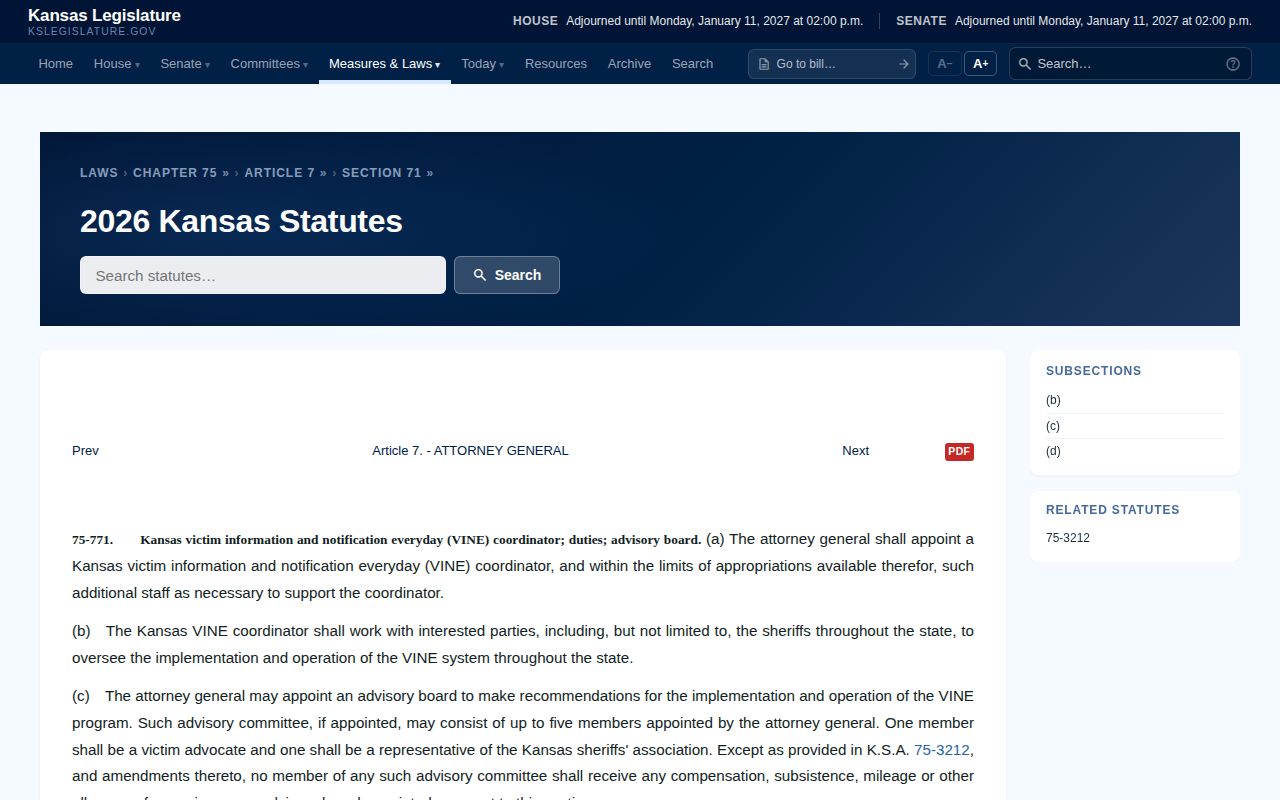
The statute supplies state context, while the live interface remains the tool for a person-level Allen County alert.
Verify an Allen County Alert
A VINE alert is strong current evidence when it matches the exact person and booking. The permanent jail record is stronger for formal details. Ask for discharge date, time, and authority, which Kansas’s retention schedule places in the permanent Jail/Commitment Record.
Temporary-hold files can follow a shorter retention path than the permanent core record. Kansas’s generic county-sheriff schedule keeps certain temporary-hold material for two calendar years after incarceration ends, while the Jail/Commitment Record is permanent. A prompt, precise request can therefore matter when the issue concerns transfer paperwork or another short-lived supporting document.
Then reconcile the case. CaseSearch may show the order that authorized release, though an order does not prove exact exit time. If the person transferred, follow the receiving custodian. If KASPER later shows an inmate or parole record, the state lane now controls that question.
- Release
- Exit from the named Allen County custody event.
- Transfer
- Movement to another custodian, not community release.
- Escape
- Unauthorized departure, never a release.
- Discharge authority
- The official basis recorded for ending county custody.
One service rarely tells the whole story. The safest conclusion names the custody that ended and avoids broader claims unless another official source proves them.
For a past Allen County event, retain the alert details and note the time received. Then request the booking-specific discharge entry if a durable record is needed. When sources conflict, the jail’s custody record controls its own release, KDOC controls a state prison event, and federal or immigration agencies control their separate custody. Results should never be blended into one unsupported conclusion.
Corrections can also follow the source. An error in the jail record goes to the Allen County custodian. A wrong judicial disposition goes to the District Court clerk because the sheriff cannot revise a court docket. A KASPER error goes to KDOC. Correcting one system does not silently correct every linked record, so keep written responses and verify the updated event where it originated.