
Allen County Projected vs Actual
KDOC calls its future field the anticipated release date. It is an estimate derived from the sentence and administrative credits. It is not a certificate that the person left prison. A later movement, parole or postrelease status, or discharged status provides stronger evidence of what actually happened.
County custody works differently. A pretrial detainee at Allen County Jail has no fixed sentence-based date. Bond, a new court order, dismissal, transfer, or another hold can change the outcome. A person serving a county sentence may have a local computation, but the KDOC formula should not be imposed on that jail term without the commitment, sentencing order, credited time, and jail calculation.
A release date must also name the custody it describes. Leaving Allen County Jail does not prove that KDOC, BOP, ICE, or another county has no hold. Leaving a Kansas prison for parole ends prison confinement but begins supervised status. A final KDOC discharge comes later when the sentence ends. These events can have separate dates and separate source records.
- Anticipated release date
- KDOC’s changeable estimate for a state prisoner.
- Actual release
- The documented end of a specific agency’s physical custody.
- Detainer
- A request or hold from another authority that may lead to transfer instead of community release.
- Discharge
- Formal completion of the KDOC sentence or another controlling term.
Find Allen County Projected Release Dates
Classify the person before searching. KASPER covers people sentenced to KDOC since 1980 who are incarcerated, supervised after prison, or discharged. It does not cover every short Allen County jail term or pretrial booking.
- For a state sentence, open KASPER, accept the disclaimer, and search by KDOC number or name.
- Use date of birth, photo, Allen conviction county, and case details to confirm identity.
- Open the record and find the exact “anticipated release date” label, then read status and movements too.
- For a county sentence, obtain the Allen court order, commitment, credited time, local computation, and discharge entry from the jail or court.
- For conflicting state calculations, call KDOC Sentence Computation at 785-296-3317.
KASPER’s conviction-county field describes where the state case arose, not where the prisoner is now housed. A person sentenced from Allen County may be held elsewhere in Kansas. The KDOC locating FAQ confirms that the anticipated date can change with earned or lost credit.
The status type is as important as the date. “Inmate” means the person remains in KDOC custody. “Parole” or another post-incarceration supervision label supports release from prison while state control continues. “Discharged” supports completion of the KDOC sentence. “Absconder” concerns alleged supervision noncompliance and does not, by itself, prove a new offense or an active warrant.
Use KASPER’s advanced fields to reduce identity errors, not to force a desired result. Search inputs can include alias, birth data, race, gender, age, conviction or supervision county, location, facility, and supervision type. The public record may also show physical description, photograph, offenses, case, facility movements, custody level, office, and disciplinary findings. Compare several fields before reading the date.
The official locating FAQ gives the KDOC guidance used to interpret an Allen County state-prison estimate.

Its wording supports using the date as a forecast and checking later status data for the real custody outcome.
Allen County Good-Time Rules
Kansas does not have one universal rule that every prisoner serves exactly 85 percent. K.S.A. 21-6821 generally caps good time at 15 percent of the prison portion for crimes committed on or after July 1, 1993. That ceiling creates the “about 85 percent” shorthand, but the statute also permits up to 20 percent for specified lower-severity nondrug and drug categories by offense date.
Credits must be earned and may be forfeited. Mandatory-minimum and off-grid rules can limit them. Program credits may also affect the estimate when a person and sentence qualify. The court sentence, offense date, severity, consecutive or concurrent structure, and KDOC administration all matter.
The 15-percent figure is a maximum good-time credit for the covered prison portion, not an automatic award and not a universal sentence rule. Likewise, the 20-percent provision is limited to the statutory categories and offense dates. A sound Allen County calculation starts with the exact judgment and offense, then lets KDOC apply the controlling law and credit record.
The official good-time statute shows the specific Kansas limits used in a KDOC computation.
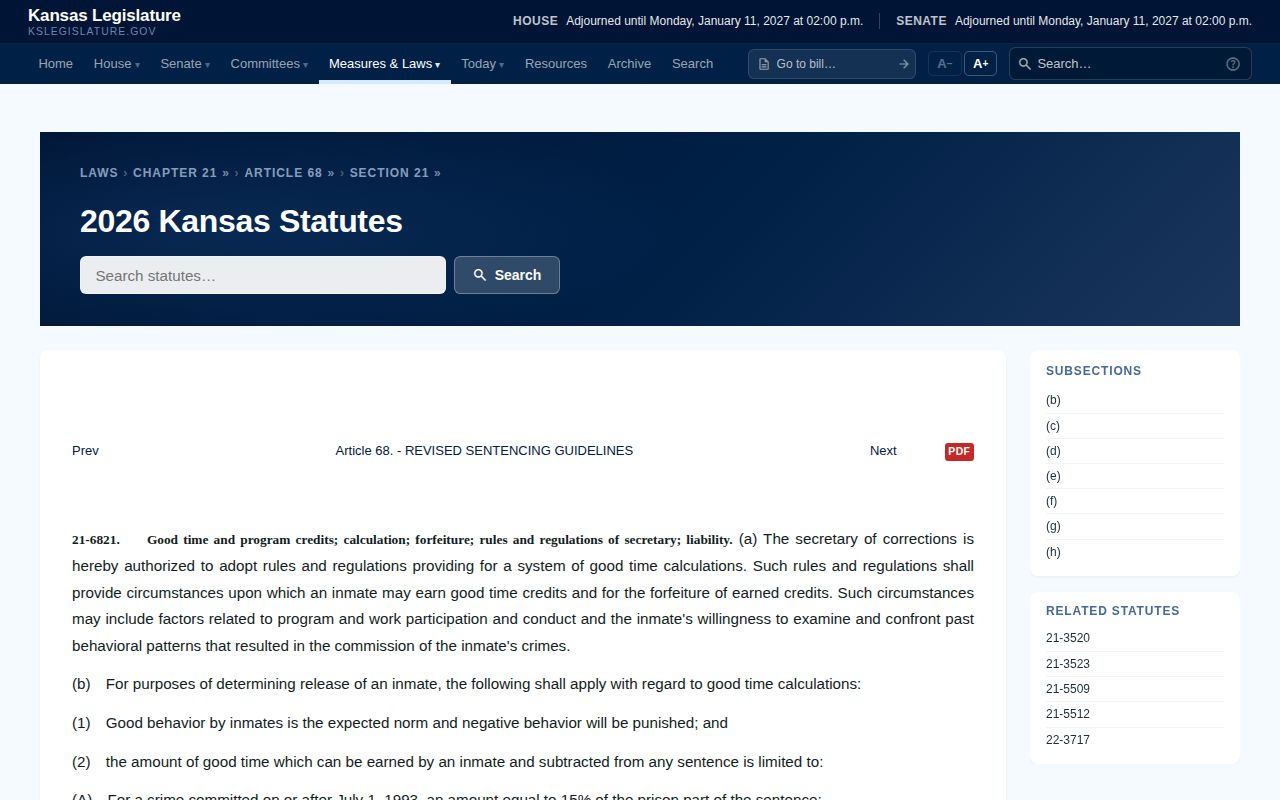
The law explains why a single percentage cannot be applied to every Allen County state sentence.
Allen County Sentence Credit
K.S.A. 21-6615 governs sentence commencement and credit for qualifying confinement or residential time. The sentencing order and records of time already served feed that part of the calculation. They should be obtained before disputing the anticipated date.
Older pre-July 1993 indeterminate sentences follow a different framework under K.S.A. 22-3725. Initial parole eligibility and conditional release use rules tied to minimum and maximum terms and retained good time. Those older terms should not be forced into the newer sentencing grid.
Sentence commencement and credited confinement are only part of the computation. Multiple terms may run at the same time or one after another. A later amended judgment may alter the structure. Keep copies of each order and compare them with the KDOC date. If a residential or jail-credit period appears missing, identify the dates and the order that grants the credit when asking the court or Sentence Computation to review it.
The Kansas sentence-credit page displays the law behind credited confinement.
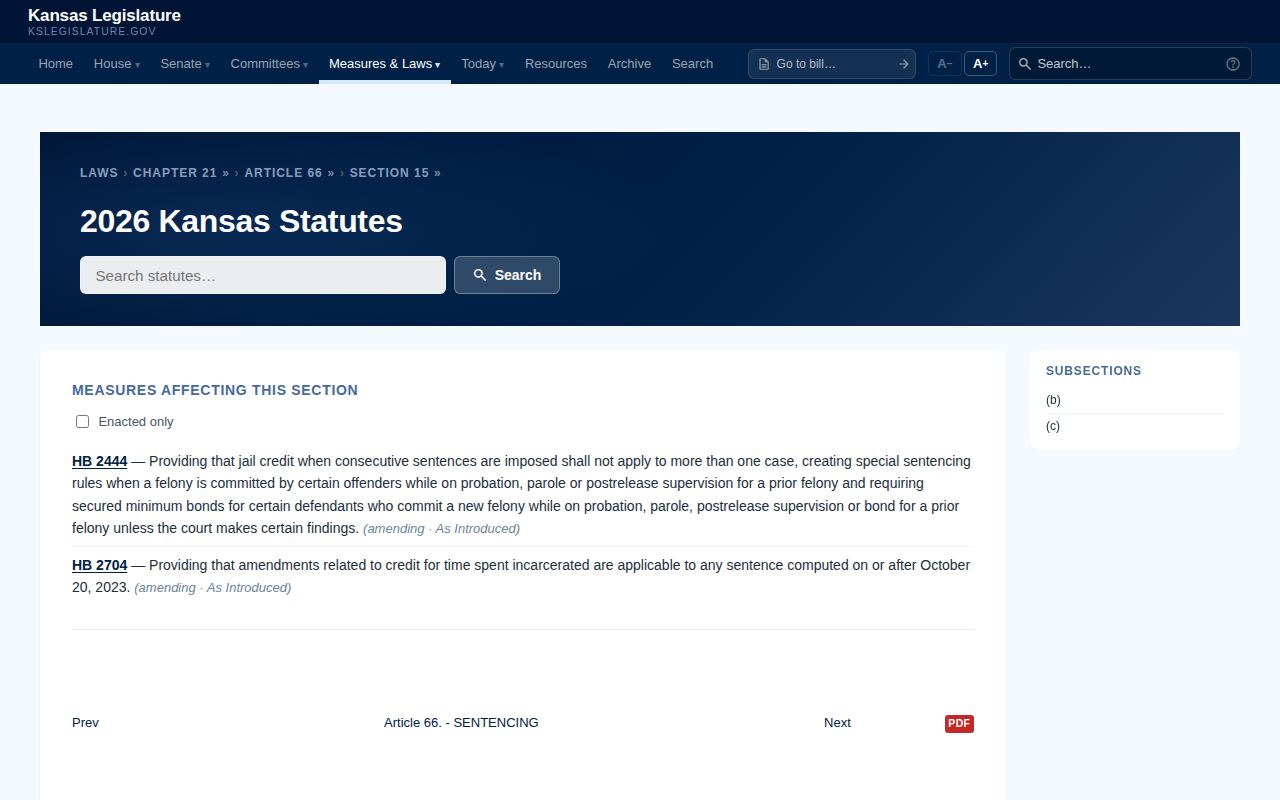
Matching the correct statute, offense date, and sentence structure is essential before estimating the date.
Why Allen County Dates Change
An anticipated release date can move in either direction. Some changes arise from conduct or earned programs. Others come from the court, a second sentence, or another authority’s hold. The displayed estimate may also lag a recent official action because KASPER updates each working day.
Program and good-time credits should be distinguished from jail or residential credit. The first group is administered under corrections rules and can be earned or lost. The second concerns time that counts toward sentence commencement under the court record and K.S.A. 21-6615. Mixing the categories can produce a plausible-looking but wrong estimate.
| Factor | Possible effect | Best record |
|---|---|---|
| Earned good time or program credit | May move an eligible estimate earlier within the law | KDOC computation and credit record |
| Forfeited credit or discipline | May move the estimate later | KDOC disciplinary and computation data |
| New or corrected court order | Can change sentence terms or credited time | Filed judicial order |
| Consecutive or concurrent sentence | Changes how multiple terms combine | Judgment and KDOC calculation |
| Detainer or hold | May cause transfer when one custody term ends | Holding and receiving agencies |
| Parole action | May affect the path from prison to supervision | Later KDOC status and movement |
A Prisoner Review Board hearing list is not a release record. It shows a scheduled process. Likewise, an expired anticipated date beside an “Inmate” status is a conflict to resolve with KDOC, not a reason to label the person released.
Detainers deserve special care. One agency can finish its sentence and transfer the person directly to another. The first agency may accurately record a release from its custody even though the person never enters the community. Ask both the releasing and receiving authority what happened, and avoid turning one agency’s end date into a claim of complete freedom.
Allen County Jail Date Computation
County-jail sentences require a local record path. Obtain the commitment, sentencing order, any amended order, credited jail or residential time, and the jail’s own computation. Ask for the final discharge date, time, and authority once custody ends. Kansas’s permanent Jail/Commitment Record retains those discharge fields.
Do not treat a bond or disposition order as proof of physical exit. The order supplies legal authority, while the jail records execution. A bond-out can end Allen County custody while the criminal case continues. A transfer can also end Allen custody while another custodian immediately takes control.
No official Allen County weekend-release rule, public release time, or dedicated projected-date portal was located in the inspected sources. The safe route is the jail at 620-365-1402 and the 31st Judicial District case record. Phrase any absence finding as “not located,” since it does not prove the agency keeps no internal calculation.
The sheriff’s FAQ directs release questions to VINE and says jail information is refreshed several times daily. Even so, no distinct Allen County date calculator or public sentence worksheet appeared in the official navigation inspected in July 2026. A person serving time in the county jail should therefore be checked through the actual court and jail records, not through a guessed web path.
Ask for the computation in concrete terms: the sentence imposed, start date used, each credited period, whether terms run together or one after another, and the resulting date. Once release occurs, ask for the separate discharge entry. Keeping the forecast and event record apart makes it easier to see whether the estimate changed or the release was delayed by another hold.
Confirm Allen County Release Dates
For county custody, the Allen County VINELink release check can report a live custody event and accept an alert registration. Kansas VINE excludes KDOC state prisoners, so it cannot verify a state-prison discharge. Confirm county details with the jail and the permanent discharge record.
For KDOC, compare the old anticipated date with later status, facility movement, and supervision office. “Parole” or another post-incarceration status supports prison exit under supervision. “Discharged” supports completion of the KDOC sentence. A future date alone proves neither.
If the date or status appears wrong, KDOC accepts written accuracy requests at kdoc_pub@ks.gov. Keep the original and corrected responses. For a judicial error, contact the District Court clerk. The jail cannot alter a judge’s order, and a web correction does not explain the effective release event unless the originating record does.
KASPER is updated each working day. A same-day movement may not appear at once, and weekends can add apparent lag. Wait for the next appropriate update when the timing is not urgent, or contact the responsible agency when it is. For a county release, VINE and direct jail contact are the live channels. For state custody, later KASPER status and KDOC confirmation carry more weight than the earlier estimate.
Note: Name the custody that ended, since release from Allen County Jail, release from KDOC prison, and final sentence discharge are distinct events.