
Federal Pretrial Custody Paths
USMS controls a federal prisoner from a federal custody order until acquittal, release, or delivery to BOP or another custodian. The person may be housed in a local or contract bed while remaining legally under federal control. Physical location does not change which agency controls the release question.
A court may order release, detention, bond, or another result. Processing and other valid holds can affect when that order is carried out. A delivery to BOP begins sentenced federal custody rather than community release. A transfer to another jail or agency also continues confinement. Use “released from USMS custody” only when that specific custody ended, and use “transferred” when another custodian received the person.
| Federal event | Meaning | Next evidence |
|---|---|---|
| Release order | The court authorizes release under stated terms. | Custodian confirmation for actual exit. |
| Detention order | Federal pretrial custody continues. | Docket and USMS-controlled record. |
| Delivery to BOP | The person enters sentenced federal custody. | BOP Locator and judgment. |
| Transfer | Custody continues with another facility or agency. | Receiving-custodian record. |
| Acquittal or dismissal | The case result may support release. | Check other holds and physical execution. |
Search District of Kansas Releases
The federal docket is usually the clearest public starting point for a pretrial detention or release decision. The U.S. District Court for Kansas provides access through PACER and courthouse terminals. Search the correct person and case, then review detention proceedings, bond conditions, release orders, later revocation, judgment, and commitment events.
- Identify the federal case number and match the defendant’s full identity.
- Review the docket for the latest detention, release, bond, or commitment order.
- Read the order’s conditions and effective terms without turning it into an unsupported exit time.
- Check whether later entries show revocation, a new hold, sentencing, or delivery to BOP.
- Seek USMS or receiving-custodian confirmation when physical movement must be established.
The U.S. District Court for Kansas court-record portal describes the available docket access.
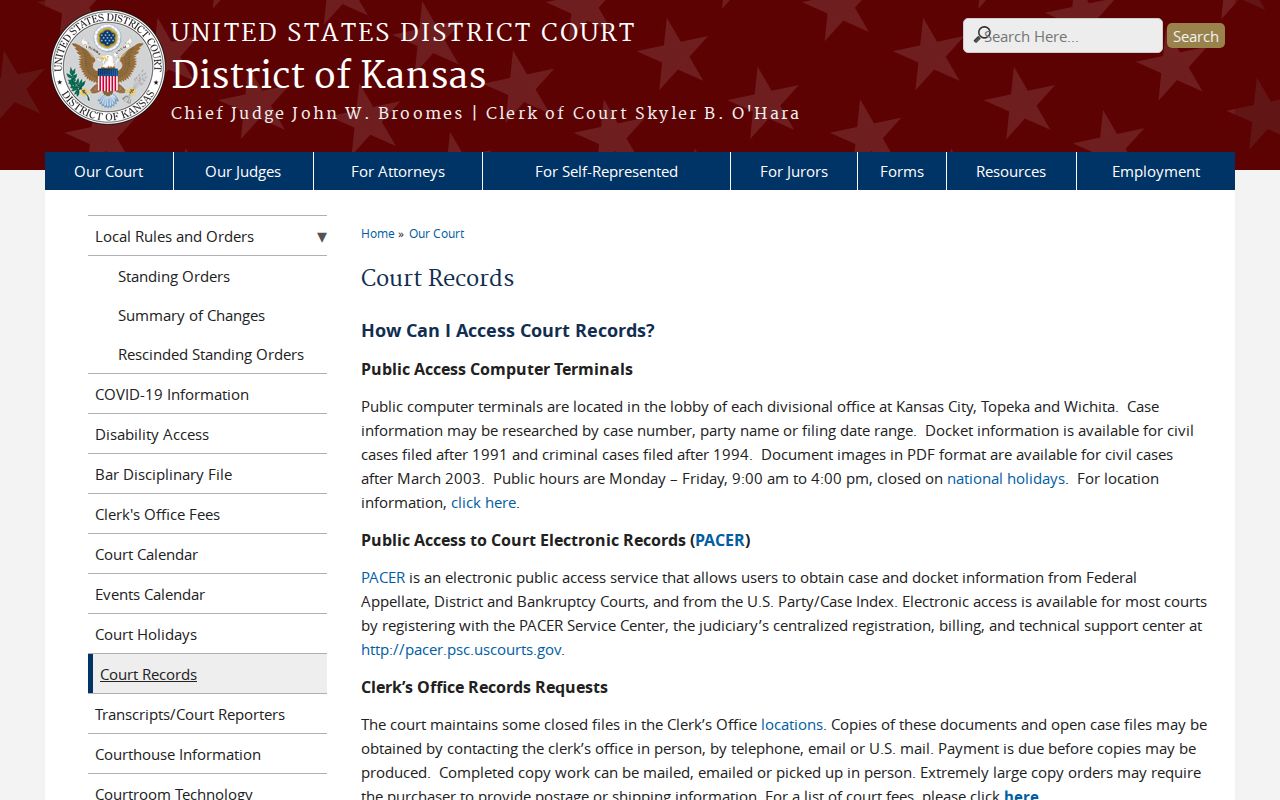
The portal provides the judicial trail, while physical custody remains a separate agency fact that may require confirmation.
No USMS Historical Release Locator
USMS offers no public historical prisoner locator. That absence is a major difference from BOP’s sentenced-prisoner system. A blank BOP search does not prove that a pretrial defendant was released because the person may never have entered a BOP sentence. Allen County VINE and KASPER also do not cover USMS custody merely because a federal defendant was arrested or housed in Kansas.
The correct fallback is the federal docket plus a focused USMS records route. If another agency received the person, use that agency’s locator or records. Do not rely on social posts, news, an old local roster, or an unverified commercial entry as a substitute for federal confirmation.
Timing should be recorded as a sequence. Note when the court entered its order, when USMS or a holding facility carried it out, and when a receiving agency accepted custody. Those times may differ without creating a true conflict. The docket is strongest for the judge’s legal act. A USMS or custodian record is stronger for the actual movement. A BOP admission is stronger for the start of a federal sentence. Keeping each event tied to its source prevents a transfer from being reported as community release.
Note: Preserve the docket date and the agency response date because legal authorization and physical movement may occur at different times.
Request Federal Pretrial Custody Records
USMS states that its records systems maintain prisoner and warrant files, but federal Freedom of Information Act exemptions, privacy limits, and fees can apply. Public prisoner photographs, histories, and movement times are restricted. Ask for a narrow agency record tied to a named person, federal case, identifier, date range, and custody event rather than requesting an undefined file.
A useful request can identify the date of the federal custody order, the District of Kansas case number, and the event sought, such as release from USMS control or delivery to BOP. Do not ask the Allen County Clerk to produce a federal prisoner file. The clerk controls county records, while USMS controls its federal records.
The USMS Freedom of Information Act route is the official request channel. Its assigned screenshot failed during capture, so no image is displayed. The source can still be used directly for request terms and agency instructions.
A focused request should avoid asking USMS to interpret the whole federal case. Identify the precise physical-custody fact sought, such as the date USMS ended control, whether the event was release or transfer, or the agency that received the person. Pair that response with the docket order rather than treating either source as complete on its own. Exemptions may limit movement detail, and a delayed or redacted response should not be filled with an assumed exit time.
When the docket later shows sentencing, check whether the judgment committed the person to BOP. That transition changes the correct public search. The BOP locator may then show admission and later release information, while USMS records remain relevant to the earlier pretrial stage. A person who was acquitted or released before a BOP commitment may never appear in the sentenced-prisoner locator.
- Pretrial custody
- Confinement before final disposition or sentence, controlled here by USMS.
- Release order
- A court direction authorizing release under stated terms.
- Physical release
- The custodian’s actual execution of the authorized exit.
- Commitment to BOP
- Delivery into the federal sentenced-custody system.
USMS Versus BOP Release
USMS and BOP handle different stages. USMS manages federal pretrial prisoners and may deliver a sentenced person to BOP. BOP’s locator covers sentenced federal custody from 1982 forward and may later show Released with a date. A person can therefore have a USMS movement, a BOP admission, and a much later BOP release.
Do not use a BOP result to fill a gap in the pretrial timeline unless the record shows the person entered BOP custody. Likewise, do not call delivery to BOP a release to the community. The federal sentenced-inmate release page explains the BOP status definitions and projected dates.
Federal Pretrial and ICE Transfers
A federal criminal custody event can be followed by ICE detention when the records support that path. Ending USMS control does not itself prove community release. ICE’s Online Detainee Locator covers current detention and people released from ICE custody during the prior 60 days. The USMS event and later ICE result remain separate.
No official source found an Allen County ICE contract facility. Do not infer a local contract from a transfer, detainer, or federal case. If ICE becomes the custodian, use the ICE locator scope and records information, and preserve the earlier USMS event as a distinct date.
No USMS Facility in Allen
The facility map describes a nationwide USMS prisoner network, not a confirmed federal pretrial facility located in Allen County. USMS often uses agreements and local beds, but the research did not establish that a named Allen County site currently holds federal prisoners under such an agreement. Do not publish a local federal release gate, schedule, or contact that the official sweep did not find.
The Old Allen County Jail is a museum and must never be presented as a present USMS detention site. The active county jail and the preserved building are also separate from federal legal custody. The Old Jail Museum record confirms the historical use only.
Allen Federal Custody Evidence
The evidence strength changes by question. A federal court order is strong proof of legal authority. USMS confirmation or an agency custody record is stronger for the exact physical event. A BOP admission shows delivery into sentenced custody. A later BOP Released status answers when BOP control ended. None should be substituted for another.
| Question | Primary source | Caution |
|---|---|---|
| Was release ordered? | District of Kansas docket | Order may precede execution. |
| Did USMS custody end? | USMS confirmation or record | No public historical locator exists. |
| Was the person sentenced to BOP? | Judgment and BOP record | Delivery is not community release. |
| Did BOP custody end? | BOP Released result/date | Other custody or supervision may remain. |
| Did Allen County custody end? | County discharge record | County record does not settle USMS status. |
The Allen County released inmate search compares the local, state, federal, and immigration lanes when the controlling agency is unclear.