
Allen County Parole or Probation
Parole, postrelease supervision, and probation all impose rules in the community, but they do not begin the same way. A person on parole or postrelease supervision has left a Kansas prison and remains under Kansas Department of Corrections control. Probation often begins with a court order that lets the person remain in the community. Allen County probation can involve court services or community corrections in the 31st Judicial District.
The source controls the meaning. KASPER, the Kansas Adult Supervised Population Electronic Repository, is the first public check for a KDOC prison sentence and later state supervision. The Allen County court record and supervising agency are more useful for local probation. KASPER itself warns that some community-corrections probation events after April 21, 2021 may not display during system modernization.
County-jail release does not settle the supervision question. A person may leave the Allen County Jail on bond and face no parole term because no state prison release occurred. Another person may leave a KDOC prison on parole after an Allen County conviction. A third may receive probation through the 31st Judicial District without entering prison. The court order, corrections record, and agency assignment identify which lane applies.
| Supervision type | How it begins | Allen County verification route |
|---|---|---|
| Parole | Release from prison under KDOC control | KASPER status, movement, and listed parole office |
| Postrelease supervision | Supervision required after the prison portion of a Kansas sentence | KASPER plus KDOC Parole Services |
| Probation | Court-ordered community supervision, often without a prison term | 31st Judicial District court services or community corrections |
| Discharge | The agency or court ends the supervision term | Later KASPER status or an official court or agency record |
These labels should not be swapped. Leaving the Allen County Jail on bond is not parole. A KDOC record marked “Discharged” means the KDOC sentence ended, while “Parole” means prison custody ended but state control did not.
- Parole
- Conditional community supervision after release from prison.
- Probation
- A court-ordered sentence served in the community under stated rules.
- Postrelease supervision
- A supervision term that follows the prison part of a Kansas sentence.
- Discharge
- The formal end of the sentence or supervision tracked by the responsible authority.
Check Allen County Post-Release Supervision
Begin with identity and jurisdiction. The same name may belong to more than one person, and an Allen County arrest does not prove a KDOC sentence. When possible, use a KDOC number. Otherwise compare birth data, photo, conviction county, case number, movement history, and supervision office before treating the record as a match.
- Open KASPER, accept its disclaimer, and search by KDOC number or name.
- Use advanced fields such as Allen conviction county, date of birth, and photo only as needed to narrow the result.
- Read the displayed type literally. “Parole” supports release from prison to supervision; “Discharged” supports completion of the KDOC sentence.
- Check movements, supervision level, and the named parole office. A future anticipated date is not proof that release occurred.
- For probation, check the underlying case through Kansas CaseSearch and contact 31st Judicial District court services because recent probation data may be absent from KASPER.
Two compatible records provide the best answer. For state parole, a KASPER parole status paired with a movement and actual supervising office is stronger than one isolated field. For local probation, a court disposition plus confirmation from the supervising unit is stronger than a blank database search.
Allen County Parole Office Route
The KDOC parole office directory places Allen County in the Coffeyville Parole Office service area. That office also serves Chautauqua, Montgomery, Neosho, Wilson, and Woodson counties. The service map is a routing aid, not person-level proof. A KASPER record may name the office that actually supervises the person.
Coffeyville Parole Office, KDOC South Region
114 W. 9th St., Suite 1
Coffeyville, KS 67337
620-232-9550
Contact the office only after confirming the correct person and Kansas supervision lane. Staff can address official supervision questions within their rules, but county coverage alone does not establish that a named person reports there. KASPER can also lag because KDOC updates it each working day rather than in real time.
The official KDOC parole contact page shows the Coffeyville service row used for Allen County.
The office listing helps route a verified parole inquiry while avoiding the false assumption that every Allen County probation matter belongs to KDOC.
Allen County Absconder Status
An “Absconder” label concerns supervision compliance or loss of required contact. It does not establish a new conviction. It also does not always prove that a warrant exists. Any warrant must be checked with the court or law-enforcement agency that would issue or hold it.
Conditions vary by sentence and supervising authority. They may govern reporting, travel, treatment, residence, or other conduct stated in the official order. A public KASPER entry is not the full set of terms. The supervising office and court record control. When a status looks stale or conflicts with a current court event, ask the responsible office to reconcile the record instead of guessing which source is newer.
Kansas VINE is not the answer for a parole violation or state-prison supervision change. The Kansas Attorney General limits VINE to county jail custody and excludes KDOC prisoners. If a person is booked again into the Allen County Jail, VINE may cover that new county custody event, but it does not replace the KDOC supervision record.
Note: An absconder status is an agency compliance label, not automatic proof of a warrant, new offense, or return to custody.
Allen County Supervision Discharge
Supervision ends through the action of the authority that controls the sentence. A KDOC record may later show “Discharged,” the clearest KASPER category for an ended KDOC sentence. Probation discharge is tied to the court and supervising program. Neither should be inferred just because a person stopped appearing in a current view or stopped reporting to one office.
KASPER retains records for people sentenced to KDOC custody since 1980 who are incarcerated, supervised, or discharged. A public conviction can remain unless removed through reversal, expungement, or executive clemency. That persistence is useful when checking whether a state sentence moved from prison to supervision and then to discharge. Yet the repository is not real time, so a written agency or court record may be needed for the exact effective date.
Allen County jail release and KDOC discharge are separate events. Someone can leave the county jail on bond with a case pending, transfer into state custody, leave prison for parole, and later complete supervision. The full county release path and release-record distinctions are covered on the Allen County released inmates search.
Allen County Release Property Record
Kansas’s permanent county Jail/Commitment Record adds a local detail that a parole database cannot answer. The record may include property and money at commitment and release, along with the discharge date, time, and authority. For a person leaving Allen County custody, those fields can document what the jail recorded as returned.
The Kansas county-sheriff retention schedule classifies the core Jail/Commitment Record as permanent and archival. Restricted fields may still be redacted. A focused request should identify the person and booking, then ask for the exact property, money, and discharge entries needed.
This record belongs to the county custody event. It does not state every later parole condition. If a jail record is wrong, contact its originating custodian. If the error is in a judicial disposition, the Allen District Court clerk is the correction route because the sheriff cannot rewrite a judge’s docket.
Allen County Probation Data Gap
Allen County sits in Kansas’s 31st Judicial District. Local court services and community corrections matter because probation can occur without a KDOC prison term. The current court-services contact route lists 620-365-1431 and fax 620-365-1434 at the Allen courthouse. Published hours conflict across sources, so calling before a visit is prudent.
The local 31st Judicial District site is the practical starting point for clerk and court-services information. Its role is distinct from the Coffeyville Parole Office. The court route addresses probation and the case order; the KDOC office addresses parole or postrelease supervision after state imprisonment.
The official 31st Judicial District page shows the local court structure used to verify Allen County probation.
Using the local court route closes the KASPER data gap without treating a blank state result as proof that probation never existed or already ended.
When asking the clerk or court-services staff for help, identify the exact Allen County case and person. A docket can establish the order, term, and later modification, while the supervising office can address current reporting status within its disclosure rules. If an order and agency statement conflict, preserve both and ask the originating court to clarify the filed disposition.
Allen County Parole Board Records
The Kansas Prisoner Review Board handles parole-related processes for qualifying state cases. Its public pages can show process terms, public-comment sessions, schedules, and people listed for coming hearings. A hearing entry is only evidence of a scheduled process. It is not a release list, an approval, or proof that someone left prison.
The Kansas Prisoner Review Board describes its role and public materials.
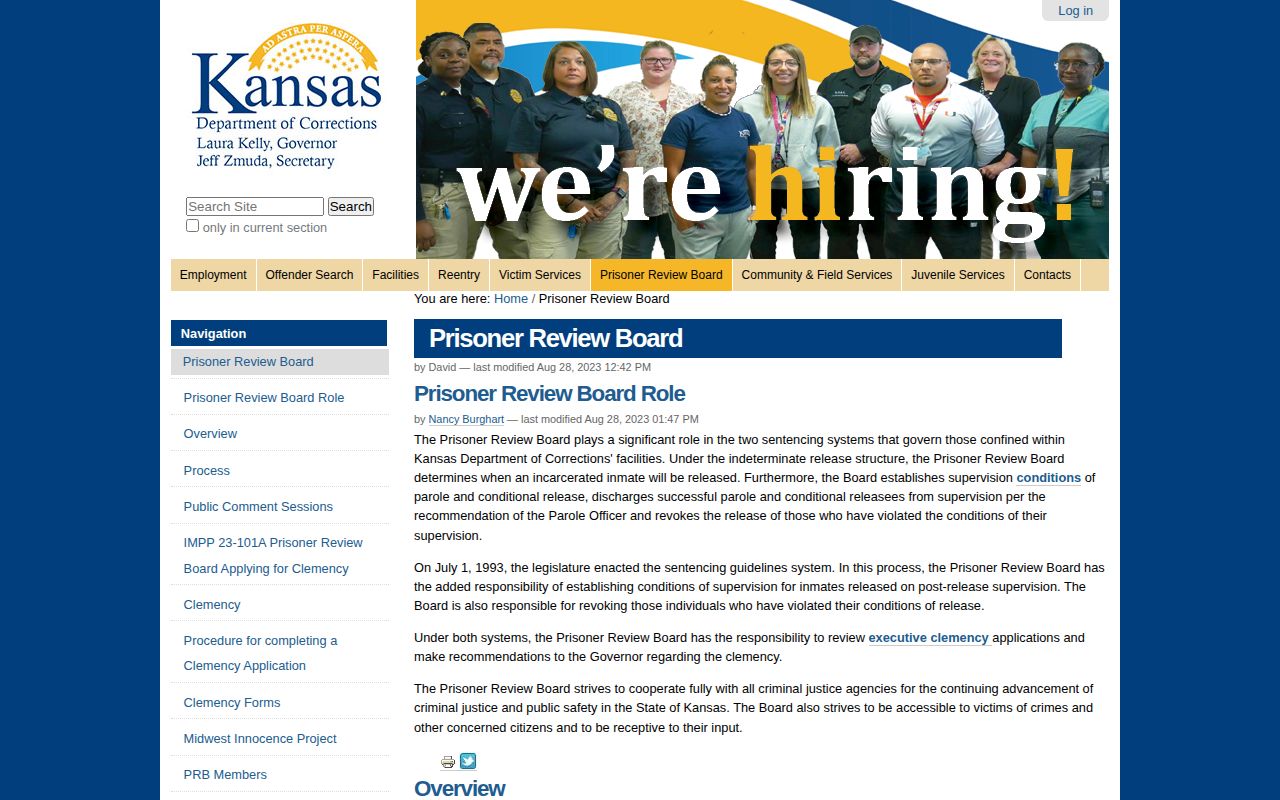
For an actual custody change, compare the later KASPER movement and status, then confirm any uncertainty with KDOC. An upcoming board event should never be converted into an assumed Allen County release date.